
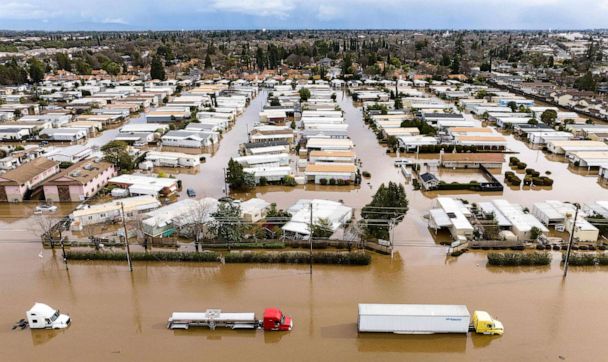
Highways disappeared beneath opaque water that concealed debris and sinkholes.
Drivers stranded on overpᴀsses waited for rescue helicopters as wind battered the rotors.
In agricultural zones, thousands of acres vanished under a reflective sheet of floodwater, threatening crops that had only recently survived years of drought.
The irony was not lost on farmers: a state that begged for rain now drowning in excess.
Meteorologists pointed to a confluence of factors — unusually warm Pacific waters, shifting jet stream patterns, and atmospheric rivers stacking in rapid succession.
Each system fed the next, preventing the land from drying between ᴀssaults.
But beyond the science, an unease took root in public discourse.
If this sequence could persist for eleven days, could it stretch to fifteen? Twenty?
Critics argued that the real story was not the storms themselves but the fragile equilibrium upon which so much of California’s development rests.
Suburbs expanded into floodplains once considered manageable risks.
Infrastructure built in the mid-20th century was asked to withstand 21st-century extremes.
The tension between growth and geography had been simmering for decades.
Now it was playing out in real time.

Some local officials privately acknowledged that contingency plans did not fully anticipate simultaneous levee stress across multiple regions.
Resources stretched thin.
Repair crews moved from one weakened section to another like firefighters battling spot blazes in a windstorm.
Every reinforcement bought time — but no one could guarantee how much.
In evacuation centers, rumors traveled faster than official updates.
One story claimed a major levee upstream was minutes from catastrophic collapse.
Another insisted federal agencies had warned of a larger system forming offshore, poised to extend the siege.
Authorities dismissed these reports as unfounded, yet the lack of clear timelines fed anxiety.
The human stories are easy to overlook amid satellite images and rainfall totals.
An elderly couple airlifted from a rooftop after waiting twelve hours for rescue.
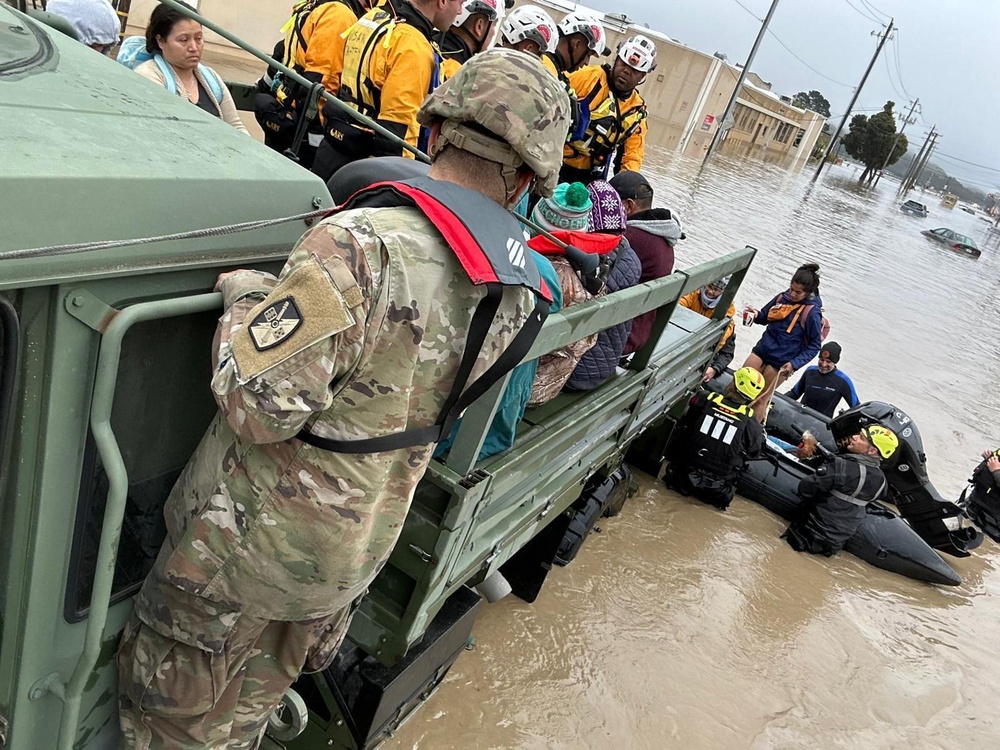
A family returning by boat to retrieve medications left behind in haste.
Children watching from shelter cots as their hometown becomes a trending hashtag.
As the eleventh day dawned, forecasts hinted at a possible break in the pattern.
Clouds thinning.
Rain tapering.
But even as precipitation slowed, rivers continued to rise, fed by runoff cascading from saturated hillsides.
The delayed crest threatened to test already compromised levees one more time.
Officials have vowed a full review once the waters recede.
There will be hearings.
Budget reallocations.
Promises to fortify and modernize.
Yet beneath the bureaucratic choreography lies a more haunting question: was this event an anomaly — or a preview?
The ground across vast stretches of California now feels altered, not just physically but psychologically.
Residents who once measured storms in days now measure them in endurance.
Eleven days is a long time to listen to rain hammer rooftops, to watch creeks swell into rivers, to wonder if the barrier between safety and catastrophe is thinner than anyone admitted.
When the skies finally clear, the reckoning will begin.
Damage ᴀssessments will tally billions.
Reconstruction plans will sketch new defenses.
But the memory of water pressing relentlessly against human-made walls will linger long after headlines fade.
For now, tens of thousands remain displaced, waiting for confirmation that the levees will hold through one more night.
And somewhere along the Pacific, moisture gathers again — silent, invisible, and patient — reminding a state built on ambition that nature rarely negotiates on human terms.