🎰 Blind Twins NEVER Saw Their Mother… When They TOUCHED the Virgin Mary, Something SHOCKING Happened

“She’s so beautiful.”
Do you believe that some things happen for a reason? That certain moments change everything without warning? Jennifer didn’t believe in any of that. Not until that Sunday in Boston.
Her two 5-year-old daughters walked into a church. They did something simple. They touched something that thousands of people touch every day. But with them, it was different. A miracle of the Virgin Mary that no one can explain.
You know that kind of mother everyone notices at the park. The one who always seems one step behind her daughters, always watching, always a little too attentive. Jennifer was like that, not out of control, out of necessity. Emma and Sophie were born blind.
Jennifer was 32 years old. She worked as a music teacher until 3 months ago when the school closed. Now she was at home sending out resumes that never got a reply, staring at the bills piling up on the kitchen table. The girl’s father, he disappeared when he found out about their condition. Said he wasn’t prepared. Jennifer never heard from him again.
The girls had a routine that worked. They woke up early, had breakfast, and navigated the house through the sounds they knew by heart. Every creak of the floor, every echo on the wall, every piece of furniture was mapped in their memory. Emma played the piano. Sophie preferred the violin. Both had hearing so sharp it impressed anyone. Jennifer watched from a distance, amazed by their independence. 5 years old and they were already doing almost everything on their own.
But there were moments when reality hit hard. Like when Emma asked, “Mommy, what does your face look like?” And Jennifer tried to describe with words something that could never be completely understood. Or when Sophie, listening to other children at the park, asked, “Why do they shout about the sky? What do they see?” Jennifer never had an answer that made sense.
The doctors had been clear from the beginning: irreversible. Jennifer spent everything she had in the first year searching for second opinions. She took the girls to specialists in three different states. The answer was always the same. There was nothing to be done. Two years ago, after the last devastating appointment, Jennifer finally accepted it. She stopped looking for cures, stopped having hope, built an entire life around the certainty that Emma and Sophie would never see. And that’s how they lived. A predictable routine, safe, limited, until that October Sunday.
Jennifer didn’t have money to do anything special with the girls, so she decided to take them for a walk around the neighborhood. It was free, and the girls loved feeling the wind on their faces as they walked hand in hand. They pᴀssed by an old church. The door was open. People were going in for mᴀss. Emma suddenly stopped.
“What’s that smell?”
Jennifer looked toward the church. “Incense. It’s coming from inside the church.”
Sophie tugged on her mother’s hand. “Can we go in?”
Jennifer hesitated. She wasn’t religious. She had stopped believing in God the day the doctors said her daughters would never see. But the girls insisted and she gave in.
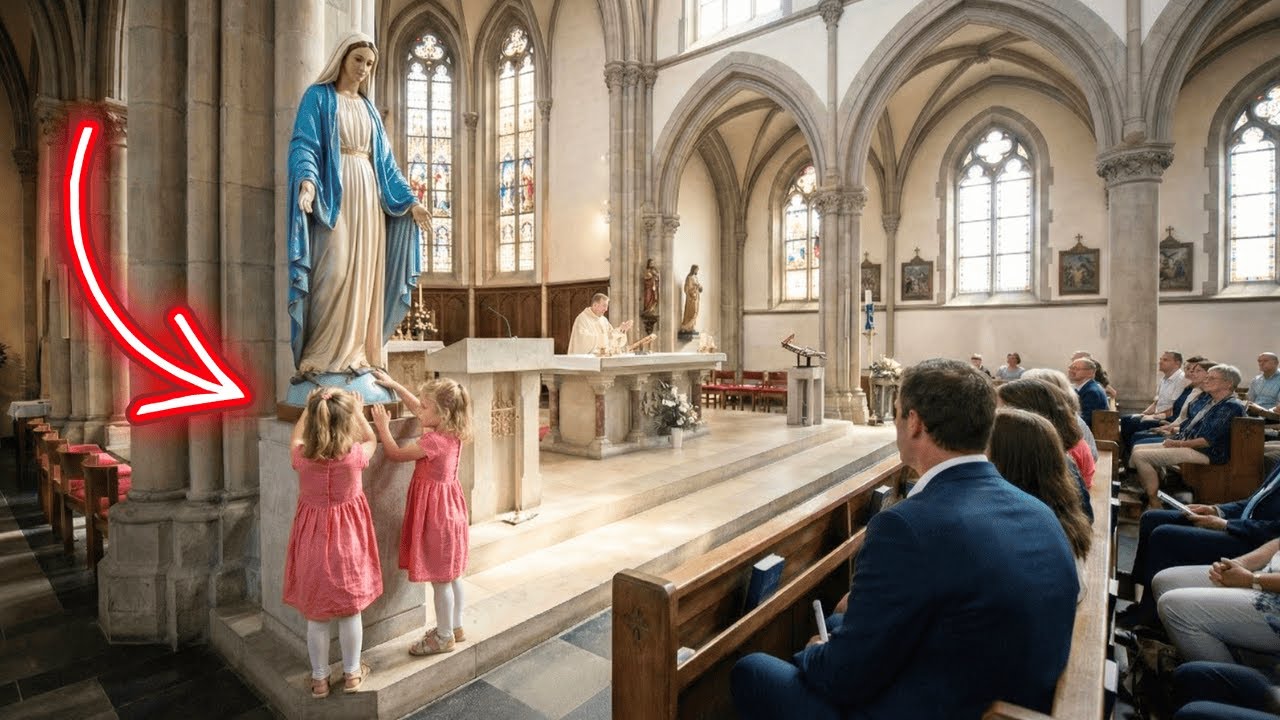
The church was full. Sunday mᴀss, whole families filling the pews. Jennifer and the girls stayed in the back trying not to draw attention. Sophie started getting restless after a few minutes. “I want to walk,” she whispered. Jennifer took them to the side aisle. Emma walked ahead, one hand lightly touching the wall to guide herself. And then she stumbled over something. Her hands touched cold stone.
“Mom, what is this?”
Jennifer approached. It was a statue, ancient marble, about a meter tall, set inside a niche in the wall. “It’s a statue of the Virgin Mary.”
Sophie came too. The two of them began exploring the statue of the Virgin Mary with their hands, the same way they did with everything new. Small fingers tracing the contours of the sculpted face, the veil, the outstretched hands of the figure. There was something almost reverent in the way they touched it, slow, careful, as if they somehow knew it was special.
Emma tilted her head, her fingers still resting on the face of the Virgin Mary, and suddenly her hands began to tremble.
“She’s beautiful,” she said softly.
“Emma.” Jennifer stepped closer.
The girl didn’t answer. She just stayed there, touching the face of the Virgin Mary. And then she began to cry. It wasn’t fear. It was something else. Something that came from a deep place.
“Emma, what is it?”
Sophie beside her also had tears streaming down her face. Her hands clutched the statue’s veil.
“Sophie, you too?”
The two girls just cried, quiet tears they couldn’t understand. Jennifer felt something break inside her. For a moment, she wanted to do something she hadn’t done in years. She wanted to whisper some desperate plea, but the words didn’t come. She had given that up long ago.
Emma and Sophie turned and hugged their mother, all three of them crying there on the cold floor of that church. She gathered the girls, wiped the tears from their little faces, and hurried out of the church, almost ashamed for even thinking about believing again.
The next three days were normal. Jennifer kept looking for a job. The girls continued their routine, everything the same, until Thursday morning. Jennifer was in the kitchen making breakfast when she heard a sound in the living room. It wasn’t a normal sound. It was different. She dropped everything and went to look. Emma was standing in the middle of the room, completely still, her hands on her face, her eyes wide open in a way Jennifer had never seen.
“Emma, what is it?”
Emma turned toward her mother’s voice. But there was something strange. Something different in the way she turned. More precise.
“Mom.” Her voice came out shaky, confused. “It’s different.”
“What’s different, sweetheart?”
“I don’t know. Something changed. I can’t explain it, but something changed.”
Jennifer knelt in front of her, her heart racing. “Changed how?”
Emma placed her hands in front of her face, moving them slowly. “When I do this, there’s something.”
Jennifer felt the ground shift beneath her feet. “Sophie,” she called, trying to keep her voice steady. “Do you feel anything different, too?”
Sophie shook her head. “No.”
“Why?” Jennifer examined Emma, looking for any sign of injury or problem. Nothing. The girl looked fine, just unsettled, confused. Jennifer tried to rationalize it. Maybe it was just imagination, but there was something in Emma’s voice, something urgent, genuinely confused, that made Jennifer stay alert.
A week pᴀssed. Jennifer had almost forgotten the incident when it happened again. It was late Thursday afternoon. Jennifer was folding clothes in the living room while the girls played with their toys on the floor. Suddenly, Sophie lifted her head. Suddenly, Sophie lifted her head. She turned toward the window.
“Mom,” she said, her voice strange. “There’s something there.”
Jennifer stopped folding the clothes. “Where, honey?”
Sophie pointed directly at the window. Where at that exact moment, people were walking on the sidewalk.
Jennifer’s heart sped up. Sophie was pointing toward the exact window where, at that moment, people were walking along the sidewalk. Jennifer could see them clearly, but Sophie… Sophie had never been able to perceive that before. Never.
“Sophie, what are you seeing?” Jennifer’s voice came out trembling.
“I don’t know, but there’s something. I know there is.”
It wasn’t a coincidence. It couldn’t be. Jennifer felt her legs weaken. She sat on the couch, breathing deeply, trying to process what she was hearing. This wasn’t possible. The doctors had been clear: irreversible. But something was happening. Something was changing.
The following week, the signs became impossible to ignore. Emma began reacting to movement. She turned her head when Jennifer walked into the room, even when she made no sound. Sophie pointed to objects on the table, not with perfect accuracy, but close. Much closer than someone who had never seen should be able to manage.
On Tuesday night, after putting the girls to bed, Jennifer sat alone in the kitchen. She picked up the phone with trembling hands and called the ophthalmologist. She managed to get an appointment for the next day. She didn’t sleep that night. She stayed awake, watching the girls sleep, trying to understand what was happening. Part of her was terrified. Another part, a part she had buried years ago, was beginning to feel something dangerous. Hope.
Dr. Miller’s office was the same as always. Jennifer held the girls’ hands while they waited. “Thompson girls,” the receptionist called. Dr. Miller received them with the same gentle smile as always. He was a man in his 60s, gray hair, round glᴀsses. He had been following Emma and Sophie since they were babies.
“So, my little ones,” he said, bending down to get on their level. “How are you doing?”
“Good,” Emma answered.
“Great. We’re going to run a few tests. All right.” He examined Emma first. He performed all the routine tests. And then he stopped.
“This is very strange,” he murmured more to himself than to anyone else.
“What is it?” Jennifer asked, her heart racing.
He didn’t answer immediately. He ran the tests again, wrote something down. Then he called a colleague, another ophthalmologist from the practice. The two of them spoke in low voices as they examined Emma again, then Sophie. Every second felt like an eternity. Jennifer clenched her hands, nails digging into her palms, trying to hold herself together.
Finally, Dr. Miller turned to her. “Jennifer, I need to be completely honest with you. Something has changed. I can’t explain what or how, but there are responses that shouldn’t be happening. Your daughters… They’re responding to visual stimuli.”
The words hit Jennifer like a punch. “What does that mean?”
“It means I’m going to refer them to a specialist. We need to understand what’s happening because this…” He hesitated, choosing his words carefully. “This shouldn’t be possible.”
Jennifer went back home in a state of shock. She put the girls to bed early, making up some excuse about them being tired. Then she went downstairs and sat alone in the kitchen. The house was silent, completely silent, only the sound of the clock on the wall marking the seconds. And then she broke down.
It wasn’t a delicate cry. It was deep, torn from a place she had locked away 5 years ago. She sat on the cold kitchen floor and let everything out. The fear, the hope, the absolute terror of believing again. “What if it stops?” she whispered into the emptiness. “What if it’s temporary? What if I let them believe?” And then she couldn’t finish the sentence.
She stayed there on the floor for she didn’t know how long until she finally managed to get up, wash her face, and go upstairs. She stepped into the girls’ room. They slept peacefully, completely unaware of their mother’s emotional storm. Jennifer knelt between their two beds, and for the first time in 5 years, she whispered something like a prayer. “If it’s you doing this, I don’t even know if you’re listening to me. I stopped believing a long time ago, but my daughters, they’re changing, so please, whatever this is, don’t let it stop.”
The following weeks were a roller coaster. Emma progressed faster than Sophie. Her visual perceptions became more frequent, clearer. She began reacting to movement in increasingly specific ways. Sophie moved more slowly. But she was changing, too. She was also beginning to perceive things she should never have been able to perceive. It wasn’t full vision. It was fragmented, confusing.
Jennifer took them to the specialist in Boston. He ran tests for 3 days. At the end of the third day, he called Jennifer in for a conversation.
“Mrs. Thompson, I’ll be direct with you. What’s happening with your daughters has no conventional medical explanation. Their visual systems were completely inactive. And now, now there is activity that shouldn’t be possible.”
“So, they’re going to… they’re going to be able to see?”
“I don’t know. Honestly, I don’t know. What I can say is that something extraordinary is happening.”
It was in the sixth week, on a Saturday morning, that the moment Jennifer would never forget happened. She woke up to a sound in the living room. She went downstairs and found Emma and Sophie standing in front of the window completely still, just staring.
“Girls,” Jennifer approached slowly.
Emma turned. “Mom,” Emma said, her voice full of awe. “I can see you.”
Jennifer stopped breathing. “What?”
Emma approached slowly, uncertain, as if navigating completely new territory. She reached out and touched her mother’s face while looking. “You’re beautiful,” she whispered.
Jennifer fell to her knees. She grabbed Emma and pulled her into a hug, crying uncontrollably. Sophie approached, too, also crying, though she still couldn’t see as clearly as her sister. They stayed there, the three of them hugging in the middle of the living room. When they finally pulled apart, Emma had a huge smile on her face.
The following months were a period of adaptation. Emma and Sophie continued to progress. Their vision wasn’t perfect. It probably never would be. There were distortions. There were limitations. But it was infinitely more than Jennifer had ever dared to hope for.
The girls started attending regular school. They needed extra support at first, helped to process all the visual information coming in at once, but they adapted. They learned colors. They learned shapes. They learned the difference between light and shadow, between near and far, between big and small. And Jennifer, Jennifer learned to believe again.
6 months after that Sunday at church, on a clear spring morning, Jennifer took Emma and Sophie back. They walked through the same door, walked down the same side aisle, and stopped in front of the statue of the Virgin Mary. But this time, the girls didn’t need to touch to know what it was they could see.
Emma reached out and gently touched the base of the statue, her eyes tracing every detail she had once known only by touch. The serene face, the blue mantle, the outstretched hands. “It was here,” she said softly.
Jennifer knelt between her two daughters. She placed her hand on the cold base of the statue and closed her eyes. “Thank you, Virgin Mary,” she whispered. Simple, direct. “Thank you for showing me that miracles still exist.”
They stayed there for a few minutes, the three of them together in silence. They didn’t need words. They didn’t need explanations. They just needed to be there in that moment, acknowledging that something unexplainable had happened.
When they left the church, Emma and Sophie ran ahead, pointing at birds in the sky, at flowers in the garden, at cars pᴀssing on the street, at everything they had only known before through sound and touch. Jennifer followed slowly, watching every movement, every gesture of admiration, and she thought about everything that had happened, about how she had given up, and about how something greater had decided to intervene exactly when she least expected it.
We don’t know why it happens. We don’t know why Emma and Sophie, why in that church, why at that moment. The doctors have no answers. Science has no explanations. And perhaps that’s exactly the point. Sometimes when we lose all hope, when we give up completely, when we build our lives around accepted impossibilities, something decides to remind us that there are still forces in the universe that challenge everything we think we know.
What we do know is that two girls who lived 5 years in complete darkness now see the world. And a mother who had stopped believing in anything beyond what she could touch learned that sometimes miracles do happen. Not in the way we expect, not when we ask, but exactly when we need them.
✓ admin
“She’s so beautiful.” Do you believe that some things happen for a reason? That certain moments change everything without warning? Jennifer didn’t believe in any of that….