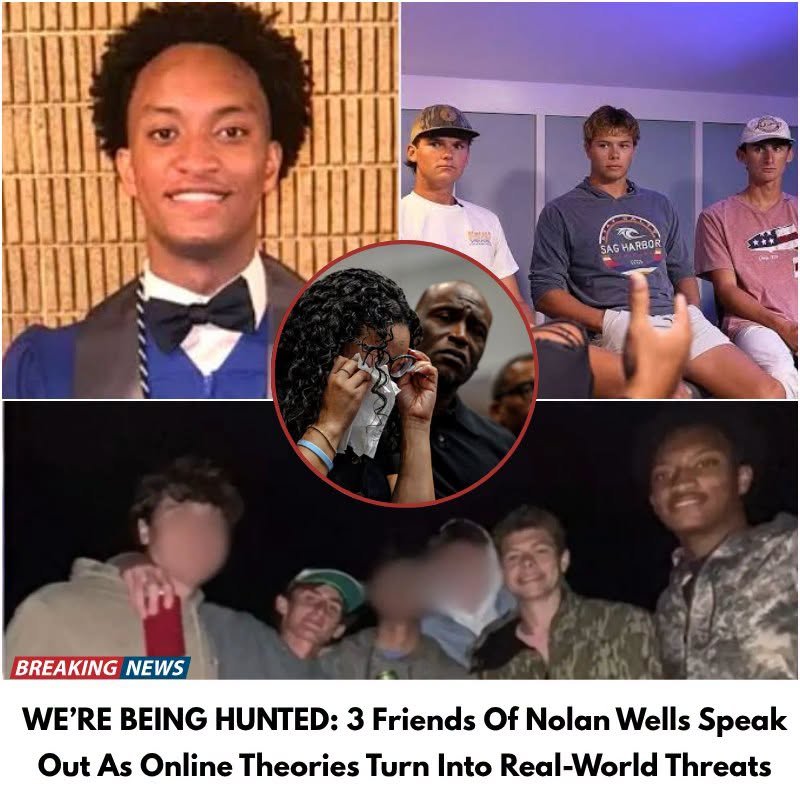
Every new piece of information seems to trigger another wave of theories.
But the attorneys representing Nolan’s friends say a dangerous line is being crossed when theories become accusations presented as proven facts — and accusations turn into real-world targeting.
Their argument is not that people should stop asking legitimate questions.
It is that questions and conclusions are not the same thing.
That distinction matters enormously.
A discrepancy can deserve investigation without proving guilt.
An unanswered question can be important without automatically pointing toward a particular person.
And an online theory, no matter how widely shared, does not become established evidence simply because thousands of people repeat it.
For the three young men, however, their attorneys say those distinctions are being lost.
They are no longer merely seeing their names discussed.
They are allegedly watching strangers construct entire narratives around them.
And according to their lawyers, their families are being dragged into the fallout as well.
That has transformed an already devastating situation into something even darker.
These are young people grieving someone they knew personally.
Nolan was not a headline to them.
He was their friend.
In previous accounts from those close to the group, the bond has been described as much deeper than a casual friendship.
They spent significant time together and considered Nolan part of their lives.
Now, the same relationships are being scrutinized through the lens of tragedy.
That can change how every ordinary memory appears.
A pH๏τograph once representing friendship can suddenly be analyzed for hidden meaning.
A casual statement can be dissected word by word.
A moment of silence can become suspicious to someone already convinced of a particular theory.
And grief itself can become evidence in the court of public opinion.
Cry too much, and someone questions whether it is genuine.
Cry too little, and someone asks why you appear emotionless.
Speak publicly, and every sentence is analyzed.
Remain silent, and silence itself becomes suspicious.
It is an impossible standard.
Now the attorneys are fighting back.
Their position is straightforward: if someone possesses genuine evidence relevant to Nolan’s death, that information should be given to investigators.
It should be examined.
It should be verified.
And if it changes the understanding of Nolan’s final hours, it should be taken seriously.
But threats are not evidence.
Harᴀssment is not investigation.
And targeting relatives does nothing to establish what happened to Nolan.
That message is becoming increasingly urgent as the emotional temperature surrounding the case rises.
Nolan’s family deserves answers.
His friends deserve to be judged on verified evidence rather than viral allegations.
Both things can be true simultaneously.
Demanding a thorough investigation does not require declaring people guilty before the facts are established.
Likewise, protecting individuals from harᴀssment does not mean legitimate questions surrounding a case should disappear.
The evidence must remain at the center.
That means witness statements should be compared against independently verifiable information.
Timelines should be reconstructed carefully.
Digital and forensic evidence should be examined by qualified investigators.
Claims should be tested.
Contradictions should be explored.
And conclusions should come afterward.
Not before.
For Warren Hudson, Jax Pitalo and Morgan Seymour, their attorneys say that principle has become painfully personal.
The three are now confronting a reality they could never have imagined when Nolan was alive: their friendship with him has become the subject of relentless public examination.
At the same time, Nolan’s mother and family remain trapped in their own devastating reality.
They lost an 18-year-old son.
They still want clarity surrounding his death.
That pain cannot be minimized.
But neither can the consequences of accusing individuals of serious wrongdoing without verified evidence.
That is why this latest development represents such a troubling turning point.
The search for answers is colliding with the dangers of internet certainty.
Social media can investigate collectively, raise important questions and draw attention to overlooked information.
But it can also make devastating mistakes.
Once a name becomes attached to an accusation, the damage can spread far beyond the original post.
ScreensH๏τs travel.
Rumors mutate.
Personal information circulates.
Families become targets.
And eventually, someone may decide that typing behind a screen is no longer enough.
That is the scenario the attorneys say they now fear.
Their warning is simple:
Let investigators investigate. Let evidence establish facts. Do not allow speculation to become a license for intimidation.
Nolan Wells deserves the truth.
His family deserves answers.
And everyone connected to his final hours deserves an investigation capable of separating what can be proven from what people merely believe.
Until that happens, one principle matters more than ever:
Ask questions. Examine evidence. Demand transparency.
But do not turn unanswered questions into a verdict.
Because if the attorneys representing Warren, Jax and Morgan are right, the consequences of that transformation are no longer confined to the internet.
They have reached the real world.
And three young men who say they are grieving their friend now claim they are also living in fear of what strangers convinced of their guilt might do next.